Microsoft is renting out its agent plumbing — and that's where your agent actually lives
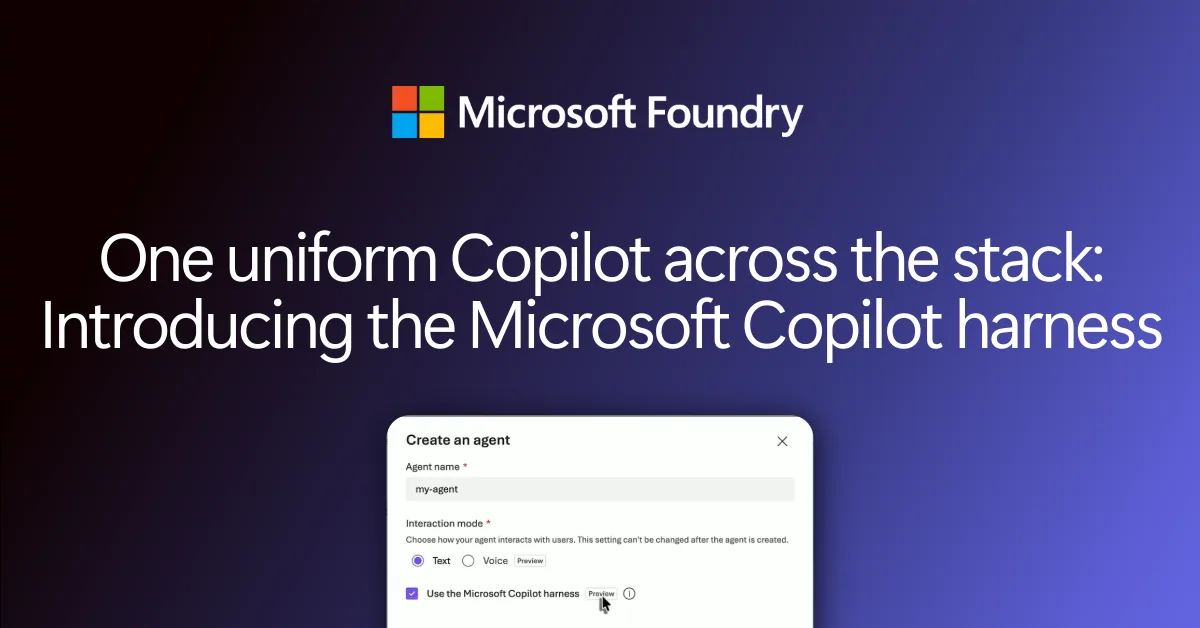
Microsoft spent October 28 making a move that is easier to miss than the model launches it sits next to: the Copilot harness, the orchestration layer already running Copilot Code, Copilot Studio, the GitHub Copilot app, the CLI and VS Code, is now exposed to outside developers through Foundry Agent Service. The runtime is free until December 1, then it becomes consumption-billed. Worth understanding before your next agent platform decision, because it is where the interesting and the sticky parts of agent engineering both live.
A harness is the machinery wrapped around a model. A model can reason about a task; completing one takes an agent loop, working context that survives twenty tool calls, file handling, a sandbox, policy limits, and something deciding which model gets the next step. Microsoft's pitch is blunt and, to be fair, largely correct: most teams building agents keep re-implementing that same execution plumbing, and it almost never differentiates their product. Build the domain expertise — the instructions, the skills, the tools — and let somebody else maintain the boring part. The engineering pedigree here isn't nothing. The harness came out of GitHub's own multi-model work, was ported to Rust to cut session overhead and time-to-first-token, and routes across 20-plus frontier models with bring-your-own-key on top.
The catch is visible in how The New Stack framed it: easy until you want to switch. Microsoft says its platforms stay open and you can still bring your own framework, and the model choice genuinely is swappable. What isn't, in practice, is the execution layer. Your agents become declarative artifacts inside Foundry — invoked through the Responses API, running a loop you don't operate, inheriting governance, context management and routing decisions tuned for Microsoft's surfaces rather than yours. Long-running resilience for hosted agents went GA in the same announcement, which is precisely the kind of capability that quietly becomes load-bearing. Lock-in used to mean a model you couldn't swap. Increasingly it means a runtime you can't lift out of.

For a small team that would otherwise burn a quarter hand-rolling tool-calling loops, this is a reasonable trade — free preview until December 1, then pay for what you consume. The discipline it requires is to price the two things separately during evaluation. Ask what survives porting: your skill files, instructions and tool definitions travel fine. The behavior you grew to rely on — how context compacts, how a stuck task resumes, how a policy violation is handled — stays behind. I'd take the managed runtime for prototypes and internal tooling, and keep anything customer-facing documented well enough that a future migration is a project rather than an archaeological dig.
Practitioners who have run agents on a managed runtime: when you eventually moved, what actually broke — the prompts, the tool plumbing, or the behavioral assumptions nobody wrote down?
Sources
- Introducing the Microsoft Copilot harness — Official Microsoft Blog
- Introducing the Microsoft Copilot harness in Foundry Agent Service — Microsoft DevBlogs
- Microsoft's new Copilot harness makes agents easy — until you want to switch — The New Stack
- Use the Microsoft Copilot harness with prompt agents — Microsoft Learn


Comments
Post a Comment