The 18,000-Token Context Tax Agents Are Finally Refusing to Pay
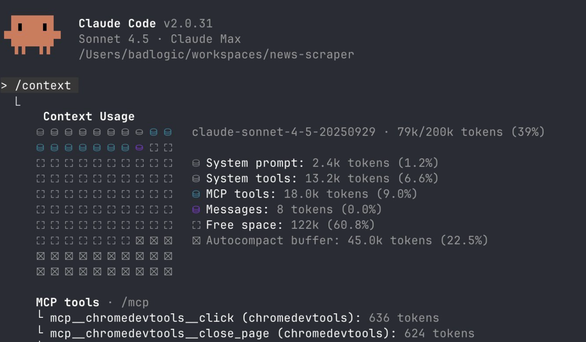
When Mario Zechner put a meter on the popular browser-automation MCP servers, the readings were hard to believe: Chrome DevTools MCP needs 26 tool definitions, roughly 18,000 tokens — about 9% of a 200,000-token context window — before the agent has done anything useful. Playwright MCP was only slightly lighter at 21 tools and 13,700 tokens. His conclusion in a November 2025 post was close to heretical for its time: what if you don't need MCP at all? He wired browser control into his own coding agent, Pi, using a handful of Bash scripts and a 225-token README, and left the protocol out for nearly a year.
MCP won the protocol war anyway — it is now built into nearly every developer-facing agent — but look at how the holdouts are finally adopting it, and you get the real story. Pi 1.0 shipped MCP support on October 1, and the manner of adoption is the interesting part. Tool definitions do not go into the prompt. Each connected server gets a one-line description, and the agent finds tools on demand through Codemode, a QuickJS sandbox where scripts call tools, run operations concurrently, and process results before anything reaches the model. That kills Zechner's other complaint: MCP results previously had to round-trip through the agent's context just to be saved to disk or combined with other output. Per-tool exposure controls let a setup expose search_code directly, keep get_* behind Codemode, and block delete_* outright. Codemode carries a 3,000-token default budget for tool declarations, and the Pi 1.0 release notes claim a leaner Codemode with roughly 40% fewer prompt tokens — a GPT-5.6 request fell from about 5,300 to 3,300 tokens.

The pattern is bigger than one coding agent. The protocol survived; the naive integration — dump every JSON schema into the system prompt and hope the model figures it out — is quietly dying. Lazy tool discovery, progressive disclosure, and sandboxed execution are the same tricks front-end developers have used for years to keep pages lean, now applied to agent tooling, because context is where an agent's attention lives. Eighteen thousand tokens of tool descriptions is not just an invoice problem; it is noise competing with your actual task, and anyone who has watched an agent pick the wrong tool out of forty has already paid that tax. Multiply it across a dozen servers and a team running agents all day, and context bloat becomes a line item on the cloud bill. Worth asking: if you audited your own agent setup, which MCP servers would actually survive a token-cost review?
Sources

Comments
Post a Comment