When Your Rival's Chip Plugs Into Your Rack
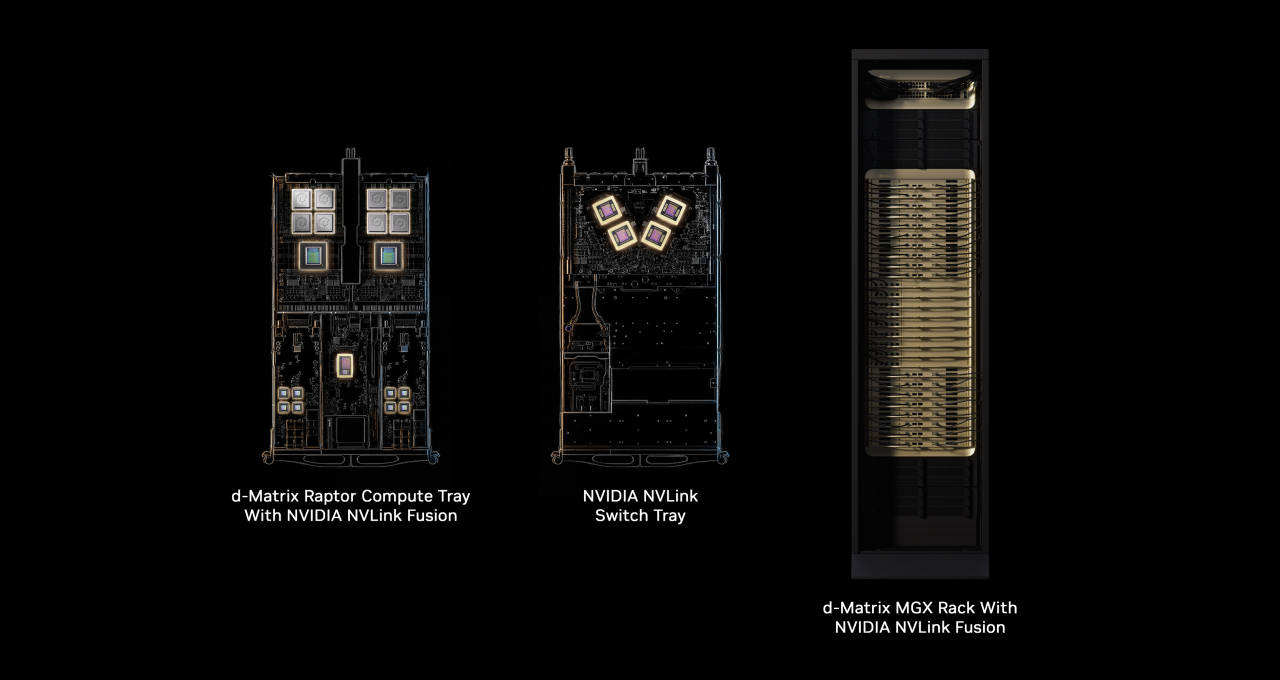
d-Matrix is about to bolt its Raptor inference chips straight into NVIDIA's rack, and the part worth staring at isn't the chip. It's the chassis. The company will use NVLink Fusion to connect its next-gen Raptor XPUs to NVIDIA's scale-up and Spectrum-X networking, riding the MGX rack architecture with Vera CPUs, BlueField-4 DPUs, and ConnectX-9 SuperNICs all in the same box. It's a multi-year roadmap, and it means a d-Matrix accelerator gets deployed inside a rack that hyperscalers and neoclouds already know how to build, power, liquid-cool, and maintain. d-Matrix gets to skip the slow, expensive grind of inventing its own power, cooling, and interconnect, and NVIDIA gets to sell the interconnect, the CPUs, and the switch fabric whether its own GPUs are even in the room. The exchange is almost exactly what you'd expect from a company that has spent a decade making the whole stack a moat.
Here's the thing people miss about NVLink Fusion: it's not a connector, it's a default. NVIDIA says the sixth-gen NVLink in these systems moves as much as 3 TB/s of all-to-all bandwidth per XPU, and the modular, cable-free trays make the whole rack the deployable unit instead of a chip you have to wire by hand. d-Matrix's own pitch leans on that: with NVLink Fusion and MGX, Raptor gets a mature, high-bandwidth, low-latency scale-up foundation without rebuilding the supply chain. ServeTheHome's Cliff Robinson framed the consequence well — even if d-Matrix wins a customer, that's a CPU socket AMD, Intel, or Qualcomm doesn't win. The rack becomes the platform, and every rival accelerator that wants to ship at AI-factory scale has to fit inside it. That's a stronger moat than any single chip, because you stop competing on silicon alone and start owning the thing the silicon has to plug into.
The tension is that this convenience comes with a cost you don't see until procurement. Adopting NVLink Fusion means standardizing your deployment on NVIDIA's rack, NVIDIA's power profile, NVIDIA's reference designs — which is e
Sources


Comments
Post a Comment