Leaked in 2022, Still Root in 2026
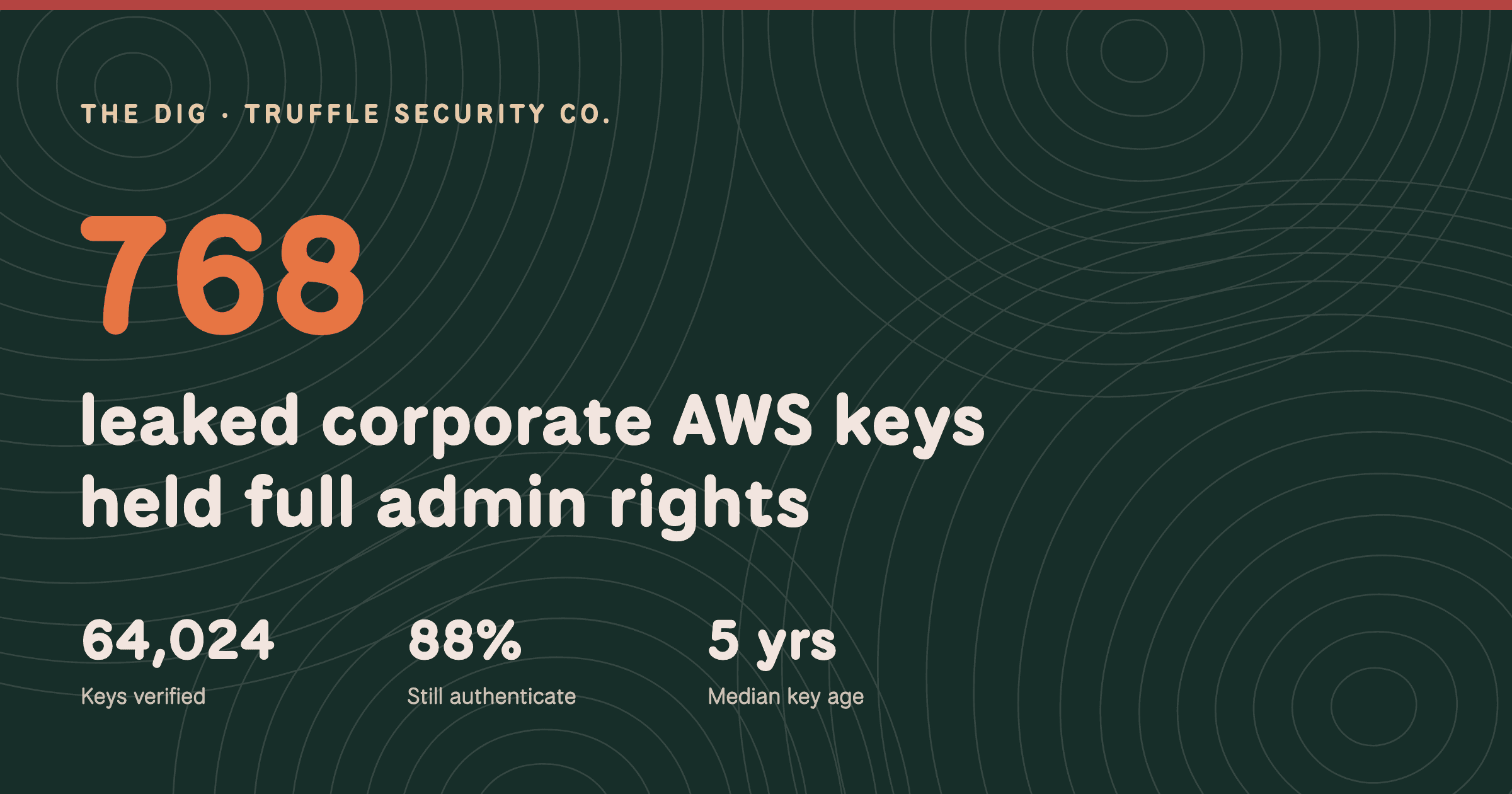
If you committed an AWS key to a public repo in 2022, here is the bad news: it probably still works. Truffle Security re-verified 10,616 publicly exposed AWS keys that had surfaced over the previous four years — in git history, Docker images, CI logs, and public datasets — and 88% of them still authenticated as of August 10, 2026. The numbers get more interesting in the corporate subset. Of the live keys, 768 give full control of a company's AWS account: 526 are root keys, 242 are IAM users carrying AdministratorAccess. Root is the scary one, because a root key can't be scoped down. In Truffle's words, it is the account, including the ability to close it. The median leaked key in the study is five years old. Five years. And most of them were never rotated.
Where the keys come from matters. Truffle's scanners found 431,875 public findings resolving to 64,024 unique verified keys across 50,654 accounts, and the single largest source was not a git repository. It was Hugging Face: 8,482 live keys across 3,394 public datasets, with 17.9% of them root — the highest root share of any source they track. Those datasets are mostly snapshots of public code repackaged for training, which means a key that leaked once gets tokenized into corpora that thousands of downstream projects download. The AI data pipeline has quietly become a credential vault with a five-year shelf life, and nobody in the chain has a job description that says check. There is a cost column, too: in July alone, leaked live keys racked up $420,631 in AWS spend, and only 262 of the 2,754 accounts Truffle could read had a budget alert set. Accounts don't die quietly in the cloud. They bill.
Every credential checklist says rotate your secrets, and that advice is technically correct and operationally hollow, because rotation is a process and processes run on the assumption that someone knows the secret leaked. That is the part that isn't true. These keys were not stolen, phished, or breached. They were public, searchable, and sitting there for years. What is missing is a feedback loop: a reason for a five-year-old key to get audited at all. Truffle's own recommendations are sound — delete root keys, audit IAM credentials by age, rotate what you find, set budget alerts, and treat any committed credential as compromised. One asterisk is worth flagging: the research shipped alongside the launch of their TruffleHog AWS Analyze scanner, so vendor research is advertising

Sources

Comments
Post a Comment